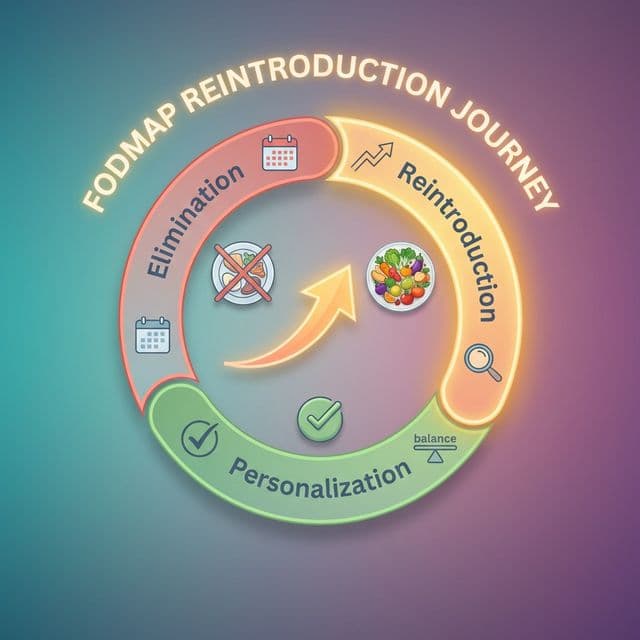
Ultimate FODMAP Reintroduction Guide: Step-by-Step Process for 2026
Key Takeaways
- FODMAP reintroduction should begin after 2-6 weeks of strict elimination
- Test one FODMAP group at a time using a structured 3-day protocol
- Always wait 3 days between tests (washout period) to avoid symptom stacking
- Approximately 75% of people with IBS can tolerate some FODMAPs in moderate amounts
- Systematic tracking is essential for identifying your personal tolerance levels
FODMAP Definition: Fermentable Oligosaccharides, Disaccharides, Monosaccharides, And Polyols. Short-chain carbohydrates that are poorly absorbed in the small intestine and may trigger IBS symptoms in sensitive individuals.
Why is FODMAP reintroduction essential?
Reintroduction is essential because the elimination phase was never designed to be permanent. According to Monash University's FODMAP protocol, the elimination phase should last only 2-6 weeks, followed by systematic reintroduction to identify individual tolerance levels.
Research published in the Journal of Gastroenterology and Hepatology (2017) found that patients who remained on strict low FODMAP diets for extended periods experienced significant reductions in beneficial gut bacteria, particularly Bifidobacteria species. This can compromise immune function, nutrient absorption, and overall gut health.
Staying on a restrictive low FODMAP diet long-term can reduce gut microbiome diversity by up to 50%, according to research published in Gut journal (2016). The National Institutes of Health (NIH) confirms that prolonged dietary restriction can negatively impact the gut microbiome. The reintroduction phase helps you discover your personal tolerance thresholds—not just "safe" vs "unsafe" foods—allowing you to eat the broadest possible diet without triggering symptoms.
When should you start reintroduction?
You're ready to begin reintroduction when:
- You've completed 2-6 weeks of strict elimination
- Your IBS symptoms have improved by at least 50%
- You're experiencing consistent, predictable bowel movements
- You're ready to commit to systematic tracking
Don't start reintroduction if:
- Your symptoms haven't improved (consult a registered dietitian)
- You're experiencing high stress or major life changes
- You have an upcoming event where symptom flare-ups would be problematic
What are the 6 FODMAP groups to test?
The low FODMAP diet targets six specific types of carbohydrates. You'll test each group separately:
1. Fructans (Oligosaccharides)
Common sources: Wheat, onion, garlic, artichokes
2. GOS (Galacto-oligosaccharides)
Common sources: Legumes, cashews, pistachios
3. Lactose (Disaccharide)
Common sources: Milk, yogurt, soft cheese, ice cream
4. Fructose (Monosaccharide - excess)
Common sources: Honey, mango, asparagus, high-fructose corn syrup
5. Sorbitol (Polyol)
Common sources: Apples, pears, cauliflower, sugar-free gum
6. Mannitol (Polyol)
Common sources: Mushrooms, sweet potato, watermelon
How does the 3-day testing protocol work?
For each FODMAP group, follow this exact protocol recommended by Monash University:
Day 1: Small Dose
Start with a small portion of a test food containing only that FODMAP group. For example, for fructans, you might eat 1 slice of wheat bread (approximately 26g).
Track: Log any symptoms (bloating, gas, abdominal pain, bowel changes) throughout the day and the following morning using a standardized symptom scale.
Day 2: Medium Dose
If Day 1 went well with no or minimal symptoms, increase to a medium portion (e.g., 2 slices of wheat bread, approximately 52g).
Track: Continue monitoring symptoms closely. Note the timing and severity of any reactions.
Day 3: Large Dose
If Day 2 was successful, try a larger portion (e.g., 3 slices of wheat bread, approximately 78g).
Track: Document any symptoms through the end of the day and into the next morning.
Washout Period: 3 Days
This is critical: Wait 3 full days before testing the next FODMAP group. This "washout" period ensures that any delayed symptoms from the previous test don't interfere with your next test.
According to research on gut transit time, FODMAPs can take up to 72 hours to fully pass through your digestive system. If you experience symptoms during the washout, extend it until you're symptom-free for 3 consecutive days.
 The structured 3-day testing protocol with mandatory washout period
How do you interpret your reintroduction results?
PASS (Safe): No symptoms or minimal symptoms across all 3 days
- Action: You can include this FODMAP group in your regular diet at tested serving sizes
PARTIAL PASS (Dose-Dependent): Symptoms only appeared at the large dose
- Action: You can eat small-to-medium amounts of this FODMAP. Note your threshold.
FAIL (Trigger): Symptoms appeared at the small or medium dose
- Action: Continue avoiding this FODMAP group for now. You can retest in 3-6 months as tolerance can change over time.
What are the most common reintroduction mistakes?
1. Testing Multiple FODMAPs at Once Testing garlic bread tests both fructans AND potentially lactose (if there's butter). Always use single-FODMAP test foods. Monash University provides a list of suitable test foods for each group.
2. Skipping the Washout Period Rushing through tests leads to "symptom stacking" where symptoms from one test overlap with the next, causing false failures and unnecessary dietary restrictions.
3. Testing During Stressful Times Research shows that stress directly impacts gut sensitivity through the gut-brain axis. Test during calm, routine periods for accurate results.
4. Not Tracking Systematically Memory is unreliable for symptom tracking. Use a food and symptom diary or tracking app to document exact serving sizes, timing, and symptom severity.
5. Giving Up Too Soon The full reintroduction process takes 6-10 weeks. Patience and consistency lead to the most accurate understanding of your personal tolerances.
How does GutWise simplify the reintroduction process?
Manual tracking can be overwhelming and error-prone. GutWise's Smart Reintroduction Engine automates the entire process:
- Automated 3-Day Protocol: The app guides you through each dose level with reminders
- Washout Timer: Automatically enforces the 3-day rest period and extends it if symptoms occur
- Symptom Correlation: Links your symptoms to specific foods and doses using validated algorithms
- Personalized Results: Builds your custom "safe foods" list based on your data
- Progress Tracking: Visual dashboards show your reintroduction journey
Instead of guessing whether yesterday's garlic or today's stress caused your symptoms, GutWise uses data to give you clear, evidence-based answers.
Related GutWiseHealth Resources
- FODMAP Assessment - Discover your gut health baseline with our clinical screener
- Understanding FODMAPs - Learn how we verify FODMAP data
- Washout Period Guide - The science of symptom stacking prevention
Sources:
- Monash University FODMAP Research. FODMAP reintroduction protocol and guidelines.
- Journal of Gastroenterology and Hepatology (2017). Effects of long-term low FODMAP diet on gut microbiota.
- Gut Journal (2016). Impact of FODMAP elimination on bacterial abundance.
- National Institutes of Health (NIH). Prolonged dietary restriction and the gut microbiome.