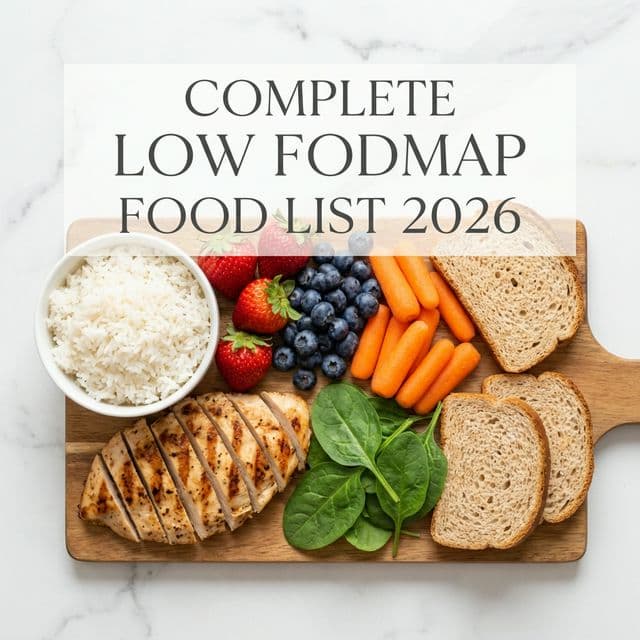
Complete Low FODMAP Food List 2026: Evidence-Based Guide
Key Takeaways
- The low FODMAP diet restricts fermentable carbohydrates that trigger IBS symptoms in 50-80% of individuals
- Serving sizes are critical—many foods are low FODMAP only in specific portions
- Based on Monash University's latest 2025 research emphasizing sustainable, personalized approaches
- This is an elimination diet (2-8 weeks), not a permanent eating plan
- The Monash FODMAP App provides the most current, research-backed serving size data
FODMAP Definition: Fermentable Oligosaccharides, Disaccharides, Monosaccharides, And Polyols—short-chain carbohydrates that may trigger digestive symptoms in sensitive individuals.
What Is the Low FODMAP Diet?
The low FODMAP diet is an evidence-based dietary approach developed by Monash University to manage Irritable Bowel Syndrome (IBS) symptoms. According to Monash University's 2025 research update, the diet is effective in 50-80% of individuals with IBS when properly implemented with dietitian support.
Recent findings from Monash University (September 2025) suggest that strict, long-term adherence may not be universally necessary. Instead, maintaining a generally healthy diet while selectively limiting individual FODMAP triggers can be equally effective while preserving gut microbiota health.
Low FODMAP Fruits (With Serving Sizes)
Portion control is essential—limit fruit intake to two low FODMAP servings per day, spaced 3-4 hours apart to prevent FODMAP stacking.
| Fruit | Safe Serving Size | FODMAP Status | Notes |
|---|---|---|---|
| Banana (firm/green) | 1 medium | ✅ Low | Ripe bananas are high FODMAP |
| Blueberries | 1/3 cup (49g) | ✅ Low | Rich in antioxidants |
| Cantaloupe | 1/2 cup | ✅ Low | Also called rockmelon |
| Grapes (all types) | 1 cup | ✅ Low | Red, white, or green |
| Kiwifruit | 2 small (peeled) | ✅ Low | High in vitamin C |
| Oranges | 1 medium (130g) | ✅ Low | Juice is also low FODMAP |
| Pineapple | 1 cup (chopped) | ✅ Low | Fresh or canned |
| Raspberries | 1/3 cup (60g) | ✅ Low | Limit portion size |
| Strawberries | 5 medium berries | ✅ Low | Versatile option |
| Papaya (yellow) | 140g | ✅ Low | Peeled and deseeded |
High FODMAP Fruits to Avoid: Apples, apricots, ripe bananas, blackberries, cherries, mango, nectarine, peaches, pears, plums, watermelon.
Low FODMAP Vegetables
Many vegetables are "eat freely" while others require portion control. Based on Monash University data:
| Vegetable | Safe Serving Size | FODMAP Status | Notes |
|---|---|---|---|
| Carrots | Eat freely (75g+) | ✅ Low | Raw or cooked |
| Cucumber | Eat freely | ✅ Low | Hydrating option |
| Lettuce (all types) | Eat freely | ✅ Low | Iceberg, romaine, arugula |
| Spinach | Eat freely | ✅ Low | Baby or English |
| Tomatoes (common) | Eat freely (65g+) | ✅ Low | Cherry, Roma, canned |
| Bell pepper (red) | Eat freely | ✅ Low | Green: 1 cup max |
| Bok choy | 1 cup (75g) | ✅ Low | Also called pak choi |
| Broccoli (florets) | 3/4 cup heads | ✅ Low | Limit stalks to 1/3 cup |
| Green beans | 15 beans (75g) | ✅ Low | Fresh or frozen |
| Kale | 1/2 cup (75g) | ✅ Low | Nutrient-dense |
| Potatoes (white) | Eat freely | ✅ Low | Versatile staple |
| Sweet potato | 1/2 cup (75g) | ✅ Low | Becomes high at 1 cup |
| Zucchini | 1/3 cup (65g) | ✅ Low | Also called courgette |
High FODMAP Vegetables to Avoid: Asparagus, cauliflower, garlic, onions, leeks (white part), most mushrooms (except oyster).
Low FODMAP Proteins
Most animal-based proteins are naturally FODMAP-free. Plant-based proteins require portion awareness.
Animal Proteins (Eat Freely)
- Meat: Beef, chicken, lamb, pork (75-100g portions)
- Fish: Cod, salmon, tuna, trout, haddock
- Seafood: Shrimp, prawns, lobster, mussels, oysters
- Eggs: 2 eggs per serving
Plant-Based Proteins (Portion-Controlled)
| Protein Source | Safe Serving | FODMAP Status |
|---|---|---|
| Firm/Extra-firm tofu | 1.5-2 oz | ✅ Low |
| Tempeh | 1 oz | ✅ Low |
| Canned black beans | 1/4 cup | ✅ Low |
| Canned chickpeas | 1/4 cup | ✅ Low |
| Canned lentils (brown) | 46g | ✅ Low |
Low FODMAP Grains
Focus on gluten-free options to avoid fructans found in wheat, rye, and barley.
| Grain/Product | Safe Serving | FODMAP Status |
|---|---|---|
| Brown rice (cooked) | 1 cup (250mL) | ✅ Low |
| White rice (cooked) | 1 cup (250mL) | ✅ Low |
| Quinoa (cooked) | 1 cup (250mL) | ✅ Low |
| Oats (dry) | 1/3 cup (30g) | ✅ Low |
| Gluten-free bread | 2 slices (54g) | ✅ Low |
| Gluten-free pasta (cooked) | 1/2 cup (125mL) | ✅ Low |
| Sourdough spelt bread | 2 slices (54g) | ✅ Low |
| Cornflakes | 1/2 cup (125mL) | ✅ Low |
Understanding FODMAP Stacking
FODMAP stacking occurs when consuming multiple low-FODMAP foods causes FODMAPs to accumulate beyond your tolerance level, even if each food is individually "safe."
How to Prevent FODMAP Stacking:
- Space meals 3-4 hours apart to allow digestion
- Limit foods with the same FODMAP type in one meal
- Use the Monash FODMAP App to check specific FODMAP types
- Prioritize naturally low-FODMAP foods like plain meats, rice, and carrots
- Limit fruit to 2 servings daily, spaced throughout the day
Low FODMAP Dairy & Alternatives
| Product | Safe Serving | FODMAP Status |
|---|---|---|
| Lactose-free milk | Unlimited | ✅ Low |
| Hard cheeses (cheddar, Swiss) | 40g | ✅ Low |
| Almond milk | 1 cup | ✅ Low |
| Coconut milk (canned) | 1/2 cup | ✅ Low |
| Rice milk | 1 cup | ✅ Low |
The Three Phases of the Low FODMAP Diet
According to Monash University's 2025 guidance:
- Elimination Phase (2-8 weeks): Strictly avoid high FODMAP foods
- Reintroduction Phase (6-10 weeks): Systematically test individual FODMAP groups
- Maintenance Phase (Ongoing): Personalize your diet based on individual triggers with dietitian support
Recent research emphasizes the importance of the maintenance phase to ensure nutritional adequacy and prevent unnecessary long-term restrictions.
Related GutWise Health Resources
- Take Our Free FODMAP Assessment - Discover your personalized FODMAP triggers
- FODMAP Reintroduction Guide - Step-by-step reintroduction protocol
- Our Methodology - How we verify FODMAP data
Important Reminders
✅ Always verify serving sizes using the Monash FODMAP App for the most current data
✅ Work with a FODMAP-trained dietitian for personalized guidance
✅ This is temporary—the goal is to identify your specific triggers, not eliminate FODMAPs forever
✅ Prioritize variety to maintain gut microbiota health
Sources:
- Monash University FODMAP Diet Research (2025). Long-term sustainability of the low FODMAP diet.
- Monash University (2025). 20 years of FODMAP research.
- Alberta Health Services (2025). Low FODMAP Diet Guide.